
Reaching 40 can feel like a financial wake-up call, especially if retirement planning at 40 was never something you expected to be thinking about.
Your 20s and 30s may have passed in a blur of building your career, raising a family, buying a home, supporting your parents and managing one financial commitment after another. Retirement may have felt too far away to worry about.
Then, almost suddenly, you are 40. That is how I felt.
I began looking at my EPF balance, savings and investments more carefully. Questions started entering my mind:
Have I saved enough? How much will I need? Have I left it too late?
If you are asking yourself these questions too, take a breath. You are not alone.
You cannot change when you started, but you can still make meaningful decisions about what happens next. Starting at 40 may require greater focus and discipline, but it does not mean that a comfortable retirement is beyond your reach.
Is 40 Too Late to Start Planning for Retirement?
The short answer is no.
If you plan to retire at 60, you may still have approximately 20 years to build your retirement funds. That is a meaningful amount of time for regular savings and investments to grow.
However, I also want to be honest with you. Starting at 40 will usually require a different approach from starting at 25.

Someone who begins earlier can contribute smaller amounts over a longer period and benefit from more years of compounding. When you begin at 40, you may need to save more each month, make careful investment decisions and review your progress more regularly.
The important thing is to begin based on your current reality.
I would never want you to look back at the years that have passed and conclude that there is no point in starting now. Every year you postpone the decision reduces the time available to you.
Why Retirement Planning at 40 Is So Important
Your 40s can be among your most financially demanding years.
You may be paying a mortgage, funding your children’s education, caring for ageing parents or dealing with rising healthcare costs. At the same time, retirement is getting closer.
Inflation also means that the money you have today may buy considerably less in the future. A lifestyle that costs RM4,000 per month today could cost much more by the time you retire.
Retirement itself may last 20 years or longer. During that time, you will still need to pay for food, utilities, transportation, healthcare, home maintenance and the activities that make retirement enjoyable.
EPF’s Retirement Income Adequacy Framework provides three savings reference levels at age 60:
- Basic Savings: RM390,000
- Adequate Savings: RM650,000
- Enhanced Savings: RM1.3 million
The Adequate Savings level is based on estimated monthly expenditure of RM2,690 for a senior single person in the Klang Valley over 20 years. You can refer to EPF’s Retirement Income Adequacy Framework. These figures can be useful reference points, but your own target should reflect your desired lifestyle, location, family responsibilities and expected retirement age.
Start by Understanding Where You Stand
Before deciding where to invest or how much to save, you need a clear picture of your present financial position.
Many people avoid this step because they are afraid of what the numbers may reveal. However, knowing your position gives you something concrete to work with.
You need to bite the bullet and give it sufficient thought. Write it down. Writing creates thinking, and your thoughts form a vision.
Here are four questions I would encourage you to answer.
1. At What Age Would You Like to Retire?
Malaysia’s minimum retirement age is currently 60, but your personal retirement age may be earlier or later.
Would you like to stop working completely at 60? Would you prefer to continue working part-time? Could you see yourself running a small business, consulting or taking on flexible work?
Your intended retirement age affects how many years you have to build your funds and how long those funds may need to support you.
2. What Would Your Retirement Look Like?
Try to picture an ordinary month in retirement.

Where would you live? Would your home be fully paid for? Would you travel regularly? Would you continue supporting your children or parents? What hobbies, religious activities or community commitments would be important to you?
Retirement planning becomes more meaningful when it is connected to the life you want to experience.
3. How Much Might You Need Each Month?
Estimate your expected retirement expenses, including:
- Housing and utilities
- Food and groceries
- Transportation
- Medical care and insurance or takaful
- Family support
- Travel and leisure
- Religious and charitable commitments
- Home repairs and emergencies
Remember to account for inflation. RM5,000 today will not have the same purchasing power 20 years from now.
4. What Resources Do You Already Have?
List everything that could support you during retirement:
- EPF savings
- Cash and fixed deposits
- Unit trusts, shares and other investments
- Property that may generate rental income
- Insurance or takaful benefits
- Business assets
- Pension or other recurring income
Once you have estimated your retirement goal and projected the future value of your existing resources, you can identify your retirement gap:
Retirement goal − projected retirement resources = estimated retirement gap
Do not be discouraged if the gap is larger than expected. Its purpose is to show you what needs to be addressed.
Six Steps to Strengthen Your Retirement Plan at 40
Once you understand your position, you can begin turning that information into action.
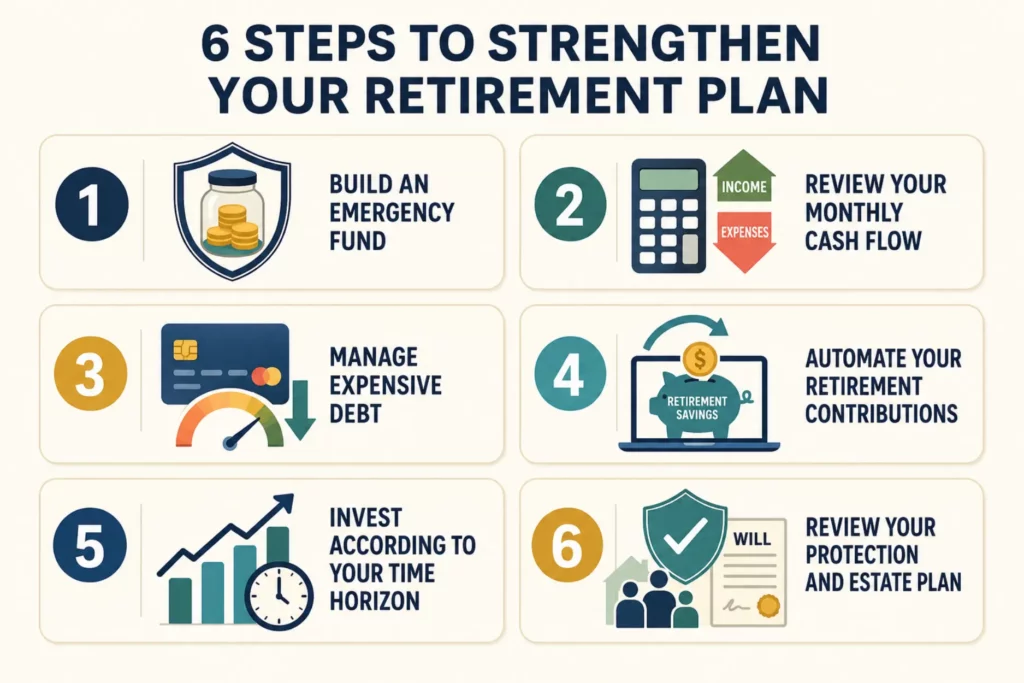
1. Build an Emergency Fund
An emergency fund helps protect your retirement savings when unexpected expenses arise.
Without one, you may be forced to sell investments, use high-interest debt or withdraw money intended for the future whenever you face a medical bill, job interruption or major repair.
The appropriate amount depends on the stability of your income and the number of people who rely on you. If saving several months of expenses feels overwhelming, begin with a smaller target and build it progressively.
2. Review Your Monthly Cash Flow
Look closely at your income and expenses.
You do not have to remove everything you enjoy. The aim is to identify spending that no longer reflects your priorities and redirect some of that money towards your future.
You could also allocate part of every salary increase, bonus or additional source of income to retirement.
I would rather see you save a manageable amount consistently than commit to an impressive figure that leaves you financially strained after two months.
3. Manage Expensive Debt
High-interest debt can make it difficult to build wealth because a significant part of your income goes towards interest payments.
Prioritise credit card balances and other expensive consumer debt. At the same time, review whether your mortgage, car financing or personal loans are likely to continue into retirement.
The right approach may involve repaying debt while continuing to build emergency and retirement savings. Your decision should consider the interest rate, your available cash and your overall financial security.
4. Automate Your Retirement Contributions
It is much easier to remain consistent when saving happens automatically.
Arrange for a fixed amount to be transferred soon after you receive your income. Treat it as a regular financial commitment rather than saving whatever happens to remain at the end of the month.
If the amount you can afford today feels small, begin there. Review it every six or twelve months and increase it when your income or cash flow improves.
Eligible Malaysians may also explore suitable voluntary EPF contributions, including the schemes available to self-employed individuals and those without a fixed income.
5. Invest According to Your Time Horizon
At 40, you may still have a long enough investment horizon to consider a diversified portfolio that supports long-term growth.
However, starting later does not mean that you should chase unusually high returns. Taking excessive risk can cause serious damage if markets fall and you do not have enough time or financial capacity to recover.
Your investments should reflect:
- The number of years until retirement
- Your ability and willingness to accept losses
- Your existing financial commitments
- The return required to meet your goal
- Your need for liquidity
- Whether you prefer conventional or Shariah-compliant solutions
Your investment strategy should also be reviewed as retirement approaches. A portfolio that is suitable at 40 may need to change by the time you are 55.
6. Review Your Protection and Estate Plan
Retirement planning can be disrupted by illness, disability or the loss of a family breadwinner.
Review your medical coverage, life insurance or takaful, critical illness protection and emergency arrangements. Make sure your coverage remains appropriate for your current responsibilities and financial position.
Your estate arrangements are equally important. Depending on your circumstances, this could include beneficiary nominations, a will, wasiat, trust or hibah arrangement.
A well-prepared estate plan can help ensure that your assets are distributed according to your wishes and that the people who depend on you are protected.
What If You Have Very Little Saved at 40?
You may have reached this point and realised that your savings are far below where you hoped they would be.
Perhaps you experienced a career interruption, used your savings during a difficult period or spent many years prioritising your family. There may be very valid reasons why you are starting from a modest position.
Your current balance tells us where the plan needs to begin. It does not decide your future.
Begin with what is possible:
- Establish your current financial position.
- Set a realistic retirement goal.
- Start contributing a sustainable monthly amount.
- Increase the contribution as your income grows.
- Direct part of bonuses and irregular income towards retirement.
- Strengthen your earning capacity where possible.
- Review whether your retirement age or expected lifestyle is realistic.
You may also consider a gradual transition into retirement. Continuing with part-time, consulting or flexible work for several years could reduce the amount you need to withdraw from your savings.
What Can 20 Years of Consistency Achieve?
Consider a person who starts contributing monthly at age 40 and continues until age 60.
The following examples assume that contributions are made monthly and earn an average return of 5% per year:
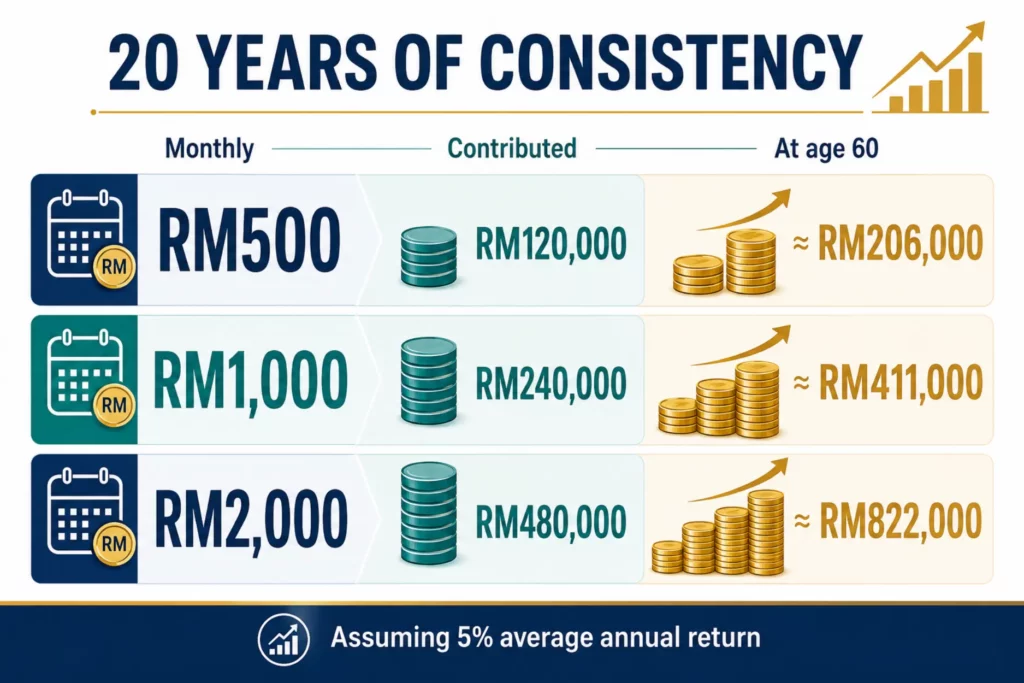
These figures show how consistency and time can work together. They also exclude any EPF savings, investments or other assets the person may already have.
The calculations are illustrations only. Actual returns will vary, fees may apply and investment returns are never guaranteed.
Retirement Planning Mistakes to Avoid in Your 40s
As you work towards your goal, be careful of these common mistakes.
Taking Excessive Risks to Catch Up
An investment promising unusually high returns can appear attractive when you feel behind. Before investing, make sure you understand how it works, the risks involved and whether it fits your plan.
Assuming EPF Will Automatically Be Enough
EPF can form an important part of your retirement resources, but you should still project whether your expected balance will support your desired lifestyle.
Ignoring Healthcare and Inflation
Your expenses will change over time. A plan based entirely on today’s prices could underestimate the amount you eventually need.
Sacrificing Your Retirement for Every Family Expense
Supporting your children is important, but using all your retirement resources for them may create a future situation in which you become financially dependent on those same children.
Balance their needs with your own long-term security.
Waiting for the Perfect Time
You may be waiting until your mortgage is smaller, your children graduate or your salary increases.
There will always be another financial commitment. Starting with an imperfect but workable plan gives you something to improve.
Failing to Review the Plan
Your income, family responsibilities, health and goals will change. Review your retirement plan at least once a year and after any major life event.
Your Retirement Plan May Need Several Sources of Support
A retirement strategy rarely depends on a single account or product.
Your future retirement income could come from a combination of:
- EPF savings
- Personal savings and investments
- Rental income
- Business income
- Insurance or takaful benefits
- Part-time employment
- Other income-producing assets
The purpose of financial planning is to bring these resources together and determine whether they can support the retirement you envision.
Your Five-Point Retirement Check-Up
If you are ready to begin, take these five steps:
1. Check your current EPF balance, savings, investments and debts.
2. Estimate the monthly income you may need in retirement.
3. Calculate the approximate gap between your goal and projected resources.
4. Decide how much you can contribute every month.
5. Review your plan at least once a year.
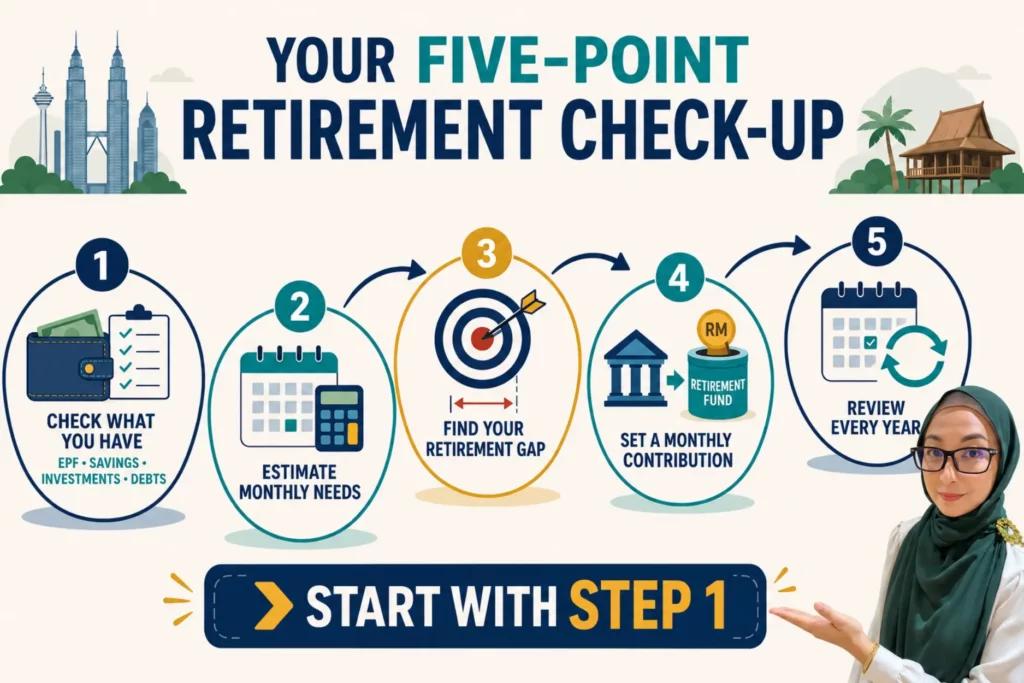
You do not have to solve everything in one day. Begin by answering the first question, then move to the next.
Final Thoughts
If you are exploring retirement planning at 40, please do not allow regret to consume the time you still have.
You may need to adjust your spending, increase your contributions or reconsider certain expectations. Some decisions may be uncomfortable at first. However, each step you take today can improve your options in the future.
Start by understanding where you stand. Make one practical decision and continue building from there.
Ready to Find Out Where You Stand?
If you are unsure whether your current savings will be sufficient, I can help you assess your position, estimate your retirement gap and explore a strategy aligned with your priorities.
Reach out to me to begin a personalised conversation about your retirement plan.
This article is intended for general educational purposes and does not constitute personalised financial or investment advice. Consider consulting a qualified financial planner before making important financial decisions.
Frequently Asked Questions
Is 40 really too late to start saving for retirement?
No. You may still have approximately 20 years before retiring at 60. However, you may need to contribute more each month and monitor your progress more closely than someone who started earlier.
How do I start retirement planning at 40?
Begin by reviewing your current EPF balance, savings, investments and debts. Next, estimate your desired retirement expenses and compare your projected resources with the amount you may need. This will help you identify your retirement gap and determine an appropriate monthly contribution.
How much should I have saved for retirement by age 40?
There is no single amount that suits everyone. Your appropriate savings level depends on your income, expected retirement age, preferred lifestyle, existing assets and family commitments. Age-based benchmarks can be useful, but a personalised projection will give you a clearer answer.
Is EPF enough for retirement in Malaysia?
It depends on your projected EPF balance and the lifestyle you want during retirement. Calculate your expected expenses and compare them with your projected EPF savings and other sources of retirement income.
Should I repay debt or save for retirement first?
The answer depends on the type of debt, its interest rate, your emergency reserves and your monthly cash flow. High-interest debt usually deserves urgent attention, although you may still need to maintain some retirement contributions and emergency savings.
Can I still retire at 60 if I start planning at 40?
It may be possible, depending on your current savings, future contributions, investment returns and expected retirement lifestyle. A retirement projection can help you determine whether age 60 is achievable or whether adjustments are needed.
Should I take more investment risk because I started late?
Taking more risk does not guarantee that you will reach your goal. Your investment approach should reflect your time horizon, knowledge, financial capacity and ability to tolerate losses.
How often should I review my retirement plan?
Review it at least once a year. You should also revisit it after a major event such as marriage, divorce, the birth of a child, a career change, salary increase, inheritance or significant health issue.