
You’ve probably heard people say that retirement planning should start as early as possible. Yet if you’re in your 20s or 30s, you may wonder, “Should I start planning retirement now?” After all, retirement still feels decades away. It can be difficult to see why retirement planning is important when you’re focused on building your career, buying your first home, getting married, or raising a young family. Retirement seems like something you’ll have plenty of time to think about later.
The truth is, retirement planning isn’t something reserved for people approaching their 50s or 60s. It’s one of the most valuable financial habits you can build while you’re still young. The earlier you start, the more time your money has to grow, and the more options you’ll have in the future.
You don’t need to be wealthy to begin planning for retirement. You simply need to understand that time is one of the greatest advantages any investor has. Whether you’re just starting your first job or you’ve been working for a few years, taking small steps today can make a remarkable difference decades from now.
In this article, we’ll explore why retirement planning for young adults matters, dispel some common misconceptions, and share practical ways you can begin preparing for a financially secure future—without sacrificing the life you want to enjoy today.
Retirement Planning Is Really About Having More Choices Later.
When people hear the word “retirement,” they often picture someone in their golden years relaxing on a beach or spending their days travelling. While that may be true for some, retirement means something much broader.
At its heart, retirement is about financial freedom.
It’s about reaching a stage in life where you have enough financial resources to decide how you want to spend your time. You may choose to continue working because you genuinely enjoy your career. You might decide to reduce your working hours, start a passion project, volunteer in your community, or spend more time with your family.
The key difference is that work becomes a choice rather than a necessity.
This is one reason retirement planning deserves attention much earlier than many people realise. The decisions you make today shape the options available to you many years from now.
Imagine two individuals who both reach the age of 60. One has accumulated sufficient savings and investments to comfortably support their lifestyle. The other has very little set aside and must continue working simply to cover everyday expenses.
Although both have reached retirement age, their experiences are vastly different.
Financial planning isn’t merely about preparing for old age. Rather, it should be perceived as creating flexibility throughout your life. You can never know when circumstances might change. You may wish to take a career break, care for ageing parents, support your children’s education, or pursue a lifelong dream. Having strong financial foundations provides choices during both expected and unexpected stages of life.
Your Greatest Investment Advantage Is Time
Many young people assume that retirement planning can wait because they don’t earn a high income yet.
Ironically, the greatest advantage they possess has nothing to do with salary.
It’s time.
Time allows your investments to benefit from the power of compounding, often described as earning returns on both your original investment and the returns you’ve already accumulated.
Consider this simple example.
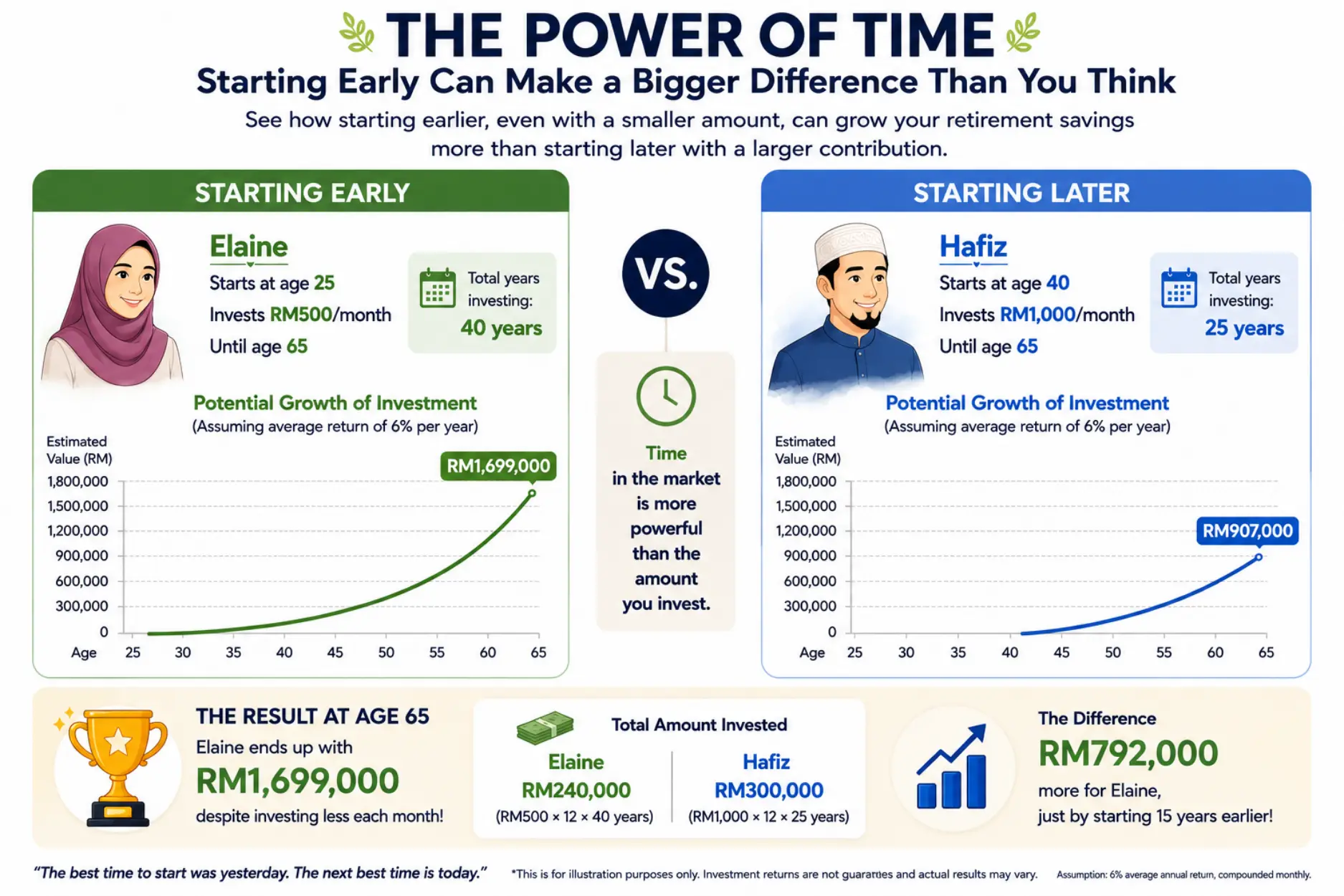
Aisyah starts investing RM500 every month at the age of 25.
Hafiz waits until he turns 40 before he starts investing. To make up for lost time, he invests RM1,000 every month—twice as much as Aisyah.
At first glance, Hafiz appears to be making the smarter financial decision because he’s contributing more money each month.
However, Aisyah has something Hafiz cannot buy back: fifteen additional years of compounding.
Those extra years allow her investments to grow upon previous growth repeatedly. Over several decades, this compounding effect can result in Aisyah accumulating significantly more wealth despite contributing less each month.
This is why financial advisers often say that time in the market is generally more valuable than trying to perfectly time the market.
If you’re wondering when should I start retirement planning, the answer is surprisingly simple:
Start as soon as you reasonably can.
You don’t need to begin with thousands of ringgit each month. Even modest, consistent contributions can grow into meaningful retirement savings over time. As your income increases throughout your career, you can gradually increase your investment contributions while allowing the power of compounding to continue working in your favour.
Small Financial Habits Matter More Than a Big Salary
A common misconception is that retirement planning only becomes meaningful once you earn a high income.
Many people tell themselves:
“I’ll start saving after my next promotion.”
“Once my salary reaches RM8,000 a month, then I’ll invest seriously.”
“Right now, I don’t earn enough for retirement planning.”
While these thoughts are understandable, they often delay action for years.
In reality, retirement planning is built far more on habits than on income.
We’ve all heard stories of individuals earning impressive salaries who still struggle financially because their spending increases just as quickly as their income. Lifestyle inflation can quietly consume every salary increment, leaving little room for long-term savings.
On the other hand, there are also many ordinary income earners who consistently set aside a portion of their salary every month. They may never become overnight millionaires, but over the course of thirty or forty years, their disciplined habits can lead to substantial financial security.
The amount you save today may seem insignificant.
RM100 a month may not feel life-changing.
RM300 a month may not appear capable of funding your retirement.
However, what matters most is developing the discipline of paying your future self first. Once that habit becomes part of your financial routine, increasing the amount later becomes much easier as your income grows.
Building strong financial habits today also prepares you for other important milestones in life, such as purchasing a home, funding your children’s education, creating an emergency fund, and achieving your broader financial planning for retirement goals.
Ultimately, retirement planning isn’t won by making one perfect investment decision. It’s built through hundreds of consistent financial decisions made over many years.
Life Rarely Goes According to Plan
When we’re young, it’s easy to believe that life will follow a predictable path. We imagine graduating, finding a stable job, receiving regular promotions, and steadily increasing our income until retirement.
While this may happen for some, life often has other plans.
Unexpected events can affect our finances in ways we never anticipated. A sudden job loss, an economic downturn, a serious illness, or the responsibility of caring for ageing parents can quickly change our financial priorities. Some people choose to take a career break to raise children, pursue further education, or even start their own business. These are all meaningful life decisions, but they may temporarily reduce income or delay savings.
The COVID-19 pandemic served as a powerful reminder that even global events can disrupt careers, businesses, and financial stability almost overnight. Many people who believed they had decades to prepare suddenly found themselves reassessing their finances.

This is another reason why start retirement planning early is such valuable advice. Starting early gives you flexibility. If life throws unexpected challenges your way, you’ll already have a financial foundation to build upon instead of starting from scratch later.
Retirement planning is not about predicting the future. It’s about preparing for uncertainty so that unexpected events don’t completely derail your long-term goals.
Inflation: The Silent Challenge to Your Retirement
One of the biggest mistakes people make is assuming that the amount of money they need today will also be enough thirty or forty years from now.
Unfortunately, that’s rarely the case.
Inflation gradually increases the cost of goods and services over time. While the changes may seem small from one year to the next, the cumulative effect over several decades can be significant.
Think about the prices your parents or grandparents paid for everyday necessities. A meal, a house, a university education, or even a visit to the doctor often cost only a fraction of what they do today.
I often think about something as simple as nasi lemak. When I was younger, I could buy a packet of nasi lemak for just a small amount of money, perhaps around RM1 or RM2. Today, the same meal can easily cost RM5 or more, depending on where I buy it. The nasi lemak may look similar, but the amount of money needed to enjoy that same meal has increased significantly over the years.
Now imagine your own retirement.
If you estimate that you’ll need RM4,000 a month to live comfortably today, that same lifestyle could require considerably more in thirty years’ time because the purchasing power of money has declined.
Healthcare costs deserve special attention. As we grow older, medical expenses often become a larger part of our monthly budget. Advances in healthcare allow us to live longer, but they can also increase the cost of maintaining a good quality of life.
This is why simply saving money in a regular bank account may not always be enough. While savings are essential for emergencies and short-term goals, long-term retirement planning often requires investments that have the potential to outpace inflation over many years.
Understanding inflation doesn’t mean worrying about the future. Instead, it helps us make informed decisions today so our savings continue to work for us rather than slowly losing value.
Retirement Is About Living the Life You Want
When people think about retirement planning, conversations often revolve around numbers.
How much should I save?
How much do I need to retire?
How much income will I receive each month?
These are important questions, but they only tell part of the story.
Behind every retirement goal is a vision of the life you hope to live.

Perhaps you dream of travelling with your spouse, spending more time with your children and grandchildren, or finally pursuing hobbies that you’ve always postponed because work was your priority.
Some people hope to volunteer for charitable organisations, mentor younger professionals, or contribute more actively to their religious or local communities. Others simply wish to enjoy a slower pace of life without constantly worrying about paying the bills.
Financial security makes these choices possible.
Without sufficient retirement savings, many people may feel forced to continue working long after they would have preferred to slow down. While there’s nothing wrong with working later in life if you enjoy it, it’s comforting to know that you have the freedom to decide.
In many ways, retirement planning is about preserving your independence.
It’s about having the confidence to make decisions based on what matters most to you rather than what your financial circumstances demand.
For younger adults, this perspective can be especially empowering. Retirement planning for young adults isn’t about giving up today’s enjoyment in exchange for an uncertain future. It’s about creating balance—enjoying your life today while steadily building a future that offers greater freedom, security, and peace of mind.
Every contribution you make, no matter how small, is an investment in the life you hope to live decades from now.
Your future self will almost certainly be grateful that you chose to begin today rather than waiting for the “perfect” time.
Common Myths About Retirement Planning
Many young adults delay retirement planning because of misconceptions they’ve heard from others or simply assumed to be true. Let’s look at some of the most common myths.
Myth 1: “I’m Too Young to Think About Retirement.”
This is perhaps the biggest misconception of all.
Being young is actually your greatest advantage. The earlier you begin, the more time your investments have to benefit from compounding. Even small monthly contributions can grow significantly over several decades.
Rather than asking, “Am I too young?”, consider asking yourself, “How much opportunity am I giving up by waiting?”
Myth 2: “I’ll Start Saving When I Earn More.”
It’s natural to believe that saving will become easier with a higher salary.
However, higher income often brings higher spending. A larger home, a newer car, more holidays, or lifestyle upgrades can quickly consume additional income if we’re not intentional with our finances.
If you develop the habit of saving a portion of your income today, you’ll find it much easier to increase that amount as your career progresses.
Good financial habits usually grow alongside your income.
Myth 3: “I Can Always Catch Up Later.”
Many people assume they can simply invest more in their 40s or 50s.
While increasing contributions later certainly helps, it can be difficult to replace decades of lost compounding. Waiting often means needing to save much larger amounts every month just to reach the same retirement goal.
Time is one resource that no one can earn back.
Myth 4: “My EPF Contribution Will Be Enough.”
Many employees contribute regularly to the Employees Provident Fund (EPF), which provides an important foundation for retirement savings.
However, it’s worth asking yourself an important question:
Will my EPF savings be enough to support the lifestyle I hope to enjoy during retirement?
Everyone’s retirement goals are different. Some people hope to travel, support their children’s future, pursue hobbies, or enjoy greater financial flexibility. Others may face rising healthcare costs or live well into their 80s or 90s.
While EPF contributions help build retirement savings over time, it’s important to review whether your projected EPF balance aligns with your long-term goals. Depending on your circumstances, you may need to consider additional savings or investments to support the retirement lifestyle you want.
Five Simple Steps You Can Take Today
The good news is that retirement planning doesn’t require a dramatic lifestyle change. Small, consistent actions often make the biggest difference over time.
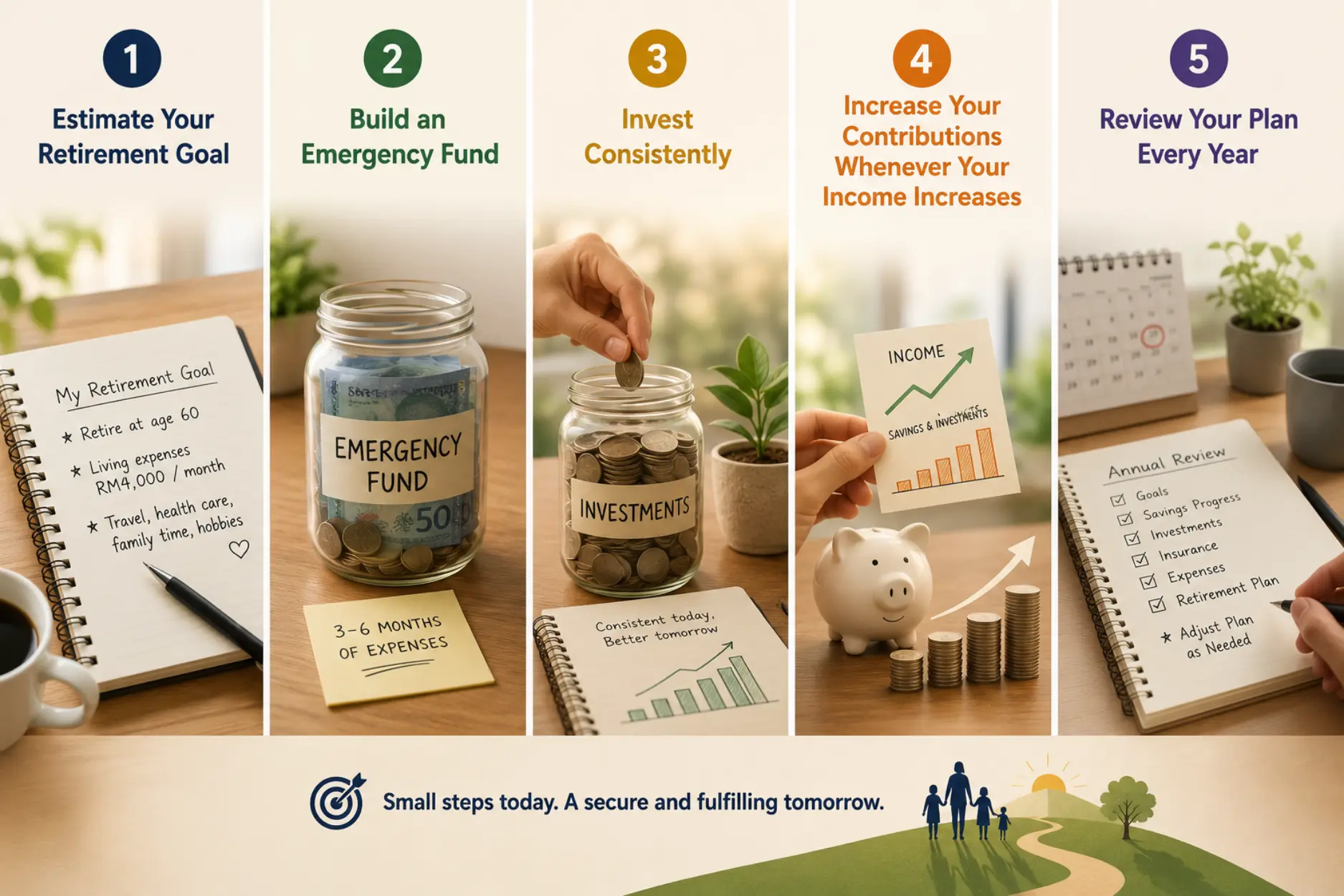
1. Estimate Your Retirement Goal
You don’t need a perfect calculation.
Simply having a rough estimate of how much monthly income you might need during retirement gives you a meaningful target to work towards. As your life circumstances change, you can review and refine your estimate.
2. Build an Emergency Fund
Before investing aggressively, establish an emergency fund that can cover several months of essential living expenses.
This financial cushion helps you navigate unexpected events without disrupting your long-term investment plans.
3. Invest Consistently
Whether you begin with RM100, RM300, or RM500 a month, consistency matters more than the starting amount.
Regular investing allows you to gradually build wealth while benefiting from long-term market growth.
4. Increase Your Contributions Whenever Your Income Increases
Whenever you receive a salary increment, bonus, or promotion, consider allocating part of that increase towards your retirement investments.
Because you’re saving from “new” income, the adjustment often feels much easier than reducing your existing spending.
5. Review Your Plan Every Year
Life changes.
Your income changes.
Your family responsibilities change.
Your retirement plan should evolve as well.
A simple annual review allows you to stay on track and make adjustments before small issues become larger problems.
Set aside one day each year to conduct a personal financial health check. Review whether your retirement savings are growing as expected, whether your monthly expenses have changed, whether your investments still align with your goals, and whether your insurance protection remains adequate. Small adjustments made consistently over time are often much easier than making drastic changes later in life.
Final Thoughts
If you’re still young, retirement may feel like a distant destination.
But retirement planning is never about preparing for the final chapter of life. Instead, it’s about creating opportunities throughout your entire journey.
Every decision you make today influences the choices available to you tomorrow.
Starting early doesn’t mean sacrificing your youth or missing out on life’s experiences. It simply means giving your future self the gift of financial flexibility and peace of mind.
No one knows exactly what the future holds. Careers change. Families grow. Priorities evolve. Unexpected opportunities—and challenges—will arise.
What you can control is the decision to begin.
Whether you start with RM100 a month or RM1,000 a month, the most important step is taking action.
Because years from now, you’ll rarely regret starting early.
You’ll only wish you had started sooner.
Ready to Take the First Step?
Retirement planning doesn’t have to be complicated. The most important decision is simply to begin.
Whether you’re in your 20s, 30s, or beyond, having a clear retirement plan can help you make more confident financial decisions today and enjoy greater peace of mind tomorrow.
If you’d like a personalised retirement planning discussion based on your financial goals, I’d be happy to help you explore your options and build a plan that’s right for you.
Schedule a complimentary consultation today.
Frequently Asked Questions
When should I start retirement planning?
The ideal time is as early as possible. Starting young gives your investments more time to grow through compounding, allowing even modest contributions to potentially accumulate into significant retirement savings over the long term.
How much should I save for retirement each month?
There isn’t a single amount that’s right for everyone. The ideal monthly contribution depends on your income, lifestyle, retirement goals, and the age at which you begin. The important thing is to start with an amount you can comfortably maintain and increase it over time.
Can I start retirement planning if I have a low income?
Absolutely. Retirement planning is more about consistency than the size of your first contribution. Developing the habit of saving and investing regularly is often more valuable than waiting until you earn a higher salary.
Is retirement planning only about investing?
No. Retirement planning also includes budgeting, managing debt, building an emergency fund, protecting yourself with appropriate insurance, and regularly reviewing your long-term financial goals.
Why should young adults think about retirement?
Young adults have one advantage that cannot be replaced—time. Starting early allows money to compound over many years, potentially reducing the amount that needs to be invested later while providing greater financial flexibility throughout life.
The goal to Retirement Planning takes time and discipline. I’m glad that able to read this blog. It is a practical and easy method. Thanks Elaine Aisyah, let’s us F. I. R. E Together 💪🏻
very inspiring article!
Great read ! I love how this article shows not only about the importance of young generations in saving money, but also for our peace of mind in future . Looking forward for more content kak elaine!