
If you are searching for practical financial habits that truly make a difference, especially as a millennial or young professional, you are not alone. Many people today want to build wealth but feel unsure where to begin. The truth is, strong financial habits for millennials and young professionals are not about quick wins or shortcuts. They are about consistent, intentional actions that shape your financial future over time. Whether you are just starting your career or looking to improve your money management, developing the right financial habits can help you build stability, confidence, and long-term wealth.
You may have heard stories of people building wealth through a successful business, a smart investment, or a major career breakthrough. These people may even be your friends, and such stories can be inspiring, but they can also make wealth feel like something that happens all at once. You may ask, “Why didn’t this happen to me?”
In reality, true lasting wealth usually comes from the financial habits you repeat every month. The way you save, spend, invest, and protect your money can have a much bigger impact over time than chasing the latest investment trend.
Whether you are starting your career, supporting a family, or planning for retirement, the habits you build today can help you create greater financial security and peace of mind.
Let me share with you seven financial habits that can help you build wealth over time. Let’s S.P.A.R.K.L.E.
Financial Habits #1 – Spend Less Than You Earn
If I could give you just one financial habit to hold on to for life, this would be it.
I know it sounds simple, but this is where real financial strength begins. No matter how much you earn, if your spending keeps rising to match your income, you will always feel like you are starting from zero. That can be exhausting. It can also leave you with very little room to save, invest, or prepare for the unexpected.
When you spend less than you earn, you give yourself breathing space. You give yourself choices. You give yourself the chance to build something bigger than just getting through the month.

And no, this does not mean you must live a joyless life. It simply means being honest with yourself about what truly matters. It means asking, “Do I really need this right now?” and “Is this purchase helping me move closer to the life I want?”
If you want to make this habit easier, start with small but meaningful steps:
- Track where your money goes each month.
- Set a budget that reflects your real life, not an ideal one.
- Pause before making impulse purchases.
- Review subscriptions and recurring expenses that no longer serve you.
These may seem like small actions, but over time, they can change the direction of your financial life. Every ringgit you do not waste is a ringgit that can work for your future.
Financial Habits #2 – Pay Yourself First
Many people tell themselves they will save whatever is left at the end of the month. But if you have ever tried that, you already know how it usually ends. There is often very little left.
That is why I always encourage people to pay themselves first.
Before you spend on anything else, set aside money for your future. Make saving a priority, not an afterthought. When you do this consistently, you are sending yourself a powerful message: your future matters.
One of the easiest ways to build this habit is to automate it. Set up a transfer to your savings or investment account as soon as your salary comes in. That way, you are not relying on willpower alone. You are creating a system that protects your goals.
I also want you to remember that saving is not only about building wealth. It is about building peace of mind. An emergency fund can protect you when life becomes uncertain. It can help you handle medical bills, job loss, or unexpected repairs without falling into panic or debt.

Start with the emergency fund. Then, once that foundation is in place, continue directing part of your income toward long-term goals.
You do not need to save a huge amount to begin. What matters most is consistency. Even small amounts, saved faithfully, can grow into something meaningful over time.
Financial Habits #3 – Automate Your Savings And Investments Early
One of the most painful things I see is people delaying investing because they think they need to wait until they have “more money” or until the market feels “right.”
But the truth is, time is one of the most valuable assets you have.
When you invest early, you give your money more time to grow. And when you stay consistent, you allow compound growth to do its work quietly in the background. That means the returns you earn can begin generating returns of their own.
This is why starting early matters so much. It is not about being perfect. It is not about having the biggest amount to begin with. It is about giving yourself the gift of time.
I know investing can feel intimidating, especially when the market moves up and down. But trying to wait for the perfect moment often leads to doing nothing at all. And doing nothing can be far more costly than starting imperfectly.

A steady approach is often the wiser one. Investing regularly over time can help reduce the emotional pressure of trying to predict market movements. It allows you to stay focused on the bigger picture instead of reacting to every short-term change.
And nowadays, it is easy to automate your savings and investments. The earlier you can do so, the faster you get to see the fruits of your money working for you.
So if you have been waiting, I want to gently encourage you: start where you are. Start with what you can. Then keep going.
Wealth is rarely built by one big decision. It is built by repeated discipline.
Financial Habits #4 – Reduce Bad Debt
I want to be very clear here: not all debt is bad.
Some debt can help you move forward in life. A home loan, for example, may help you secure a place for your family. Financing for a business may help you create income and opportunity. Used wisely, debt can be a tool.
But bad debt is different.
High-interest consumer debt, especially unpaid credit card balances, can quietly drain your future. It can make you feel trapped, stressed, and constantly behind. And the longer it stays unpaid, the harder it becomes to break free.
This is because interest works in two very different ways.
When you invest, compound interest can help your money grow.
When you carry expensive debt, compound interest can work against you and make repayment much harder.
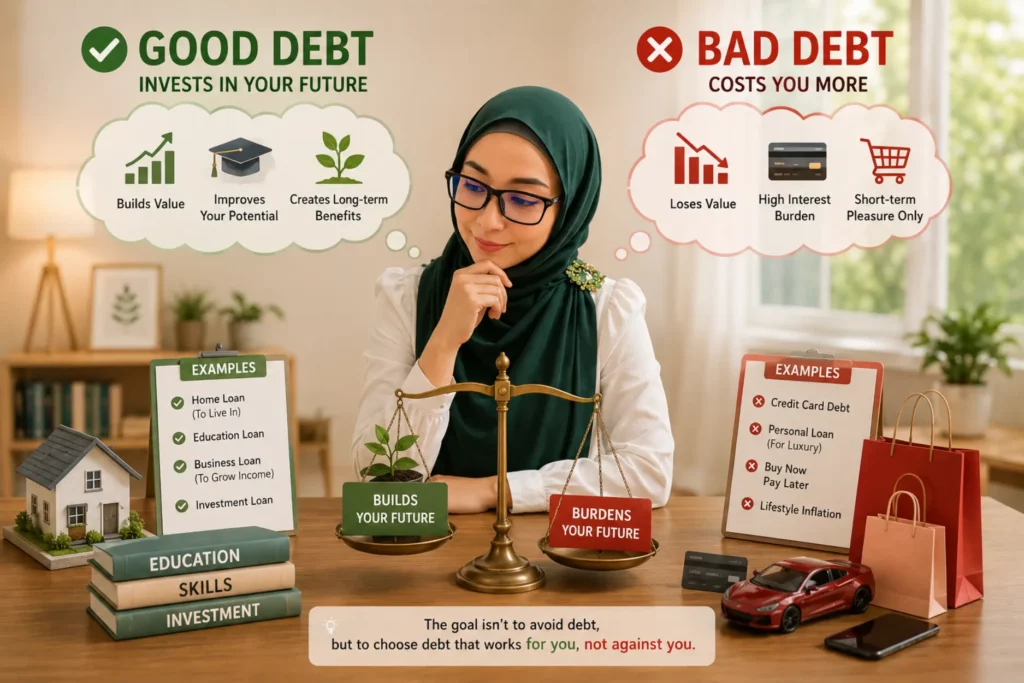
That is why I always encourage people to pause before borrowing. Ask yourself:
- Do I truly need this purchase?
- Will this debt help improve my future?
- Can I repay it comfortably without harming my other goals?
These questions may seem simple, but they can save you from years of financial pressure.
I know it is tempting to use debt for convenience or instant gratification. But every borrowing decision has a future cost. Choosing carefully today can protect your peace tomorrow.
Financial Habits #5 – Keep Learning About Money
If there is one thing I wish more people understood, it is that financial knowledge is not reserved for experts.
You do not need to know everything. You do not need to become a finance professional. But you do need to keep learning, because money is always changing. Tax rules change. Investment products change. The economy changes. And if you stop learning, it becomes easier to make decisions that do not serve you well.
The good news is that learning about money does not have to be overwhelming. It can be simple, steady, and practical.
You can begin by:
- Reading books on personal finance.
- Following credible financial educators.
- Attending seminars or workshops.
- Reviewing your financial goals each year.
- Seeking professional advice when necessary.
The more you understand, the more confident you become. And confidence matters, because when you feel informed, you are less likely to make fear-based decisions.

I always believe that financial education is empowering. It helps you move from confusion to clarity, from hesitation to action. And that shift can change your entire financial future.
Financial Habits #6 – Look After Your Protection Planning
Building wealth is important, but protecting it is just as important.
This is something many people overlook. They work hard for years, save diligently, invest carefully, and build assets with great effort. But they do not always stop to ask, “What happens if life takes an unexpected turn?”
Illness, disability, accidents, or the loss of a loved one can change everything very quickly. And when there is no protection in place, even a strong financial foundation can become vulnerable.

That is why a good financial plan should not only focus on growth. It should also focus on protection.
This may include:
- Adequate insurance coverage.
- Emergency savings.
- Estate planning.
- Updated beneficiary nominations.
- A will or estate distribution plan where appropriate.
I know these topics can feel uncomfortable. Many people prefer to avoid them because they are tied to difficult emotions. But protecting your wealth is an act of love. It is how you make sure the people who depend on you are cared for, even if you are not there to guide every decision.
You have worked hard for what you have. Protecting it means making sure your effort does not disappear when life becomes uncertain.
Financial Habits #7 – Empower Others Through Purposeful Giving
Wealth is not only about what you keep. It is also about what you choose to do with what you have.
This is a habit that speaks to the heart of who we are. When you give with purpose, you remind yourself that money is not just for accumulation. It is also a tool for kindness, responsibility, and impact.
Many people find deep fulfilment in supporting their families, helping their communities, and contributing to causes they care about. For Muslims, practices such as zakat and sadaqah carry even deeper meaning. They are not only acts of generosity, but also expressions of gratitude, discipline, and faith.
Giving can be incredibly grounding. It reminds us that wealth is a blessing, but also a trust. It encourages us to stay humble and to remember that our resources can do good beyond our own lives.

For everyone, intentional giving can strengthen communities and create a sense of purpose that money alone can never provide.
I also want to say this: giving should be thoughtful and sustainable. It should be part of your financial plan, not something that leaves you feeling strained or guilty. When you plan your giving wisely, you can be generous while still protecting your own financial stability.
That balance matters.
Final Thoughts
Building wealth is rarely about making one perfect financial decision.
Instead, it is the result of thousands of small, disciplined choices repeated consistently over many years.
You do not need a perfect income or perfect timing to begin. You simply need to start.
Take a moment to think about the life you want to create for yourself and the people you love. The habits you choose today can shape not only your finances, but also your sense of freedom, confidence, and peace in the years ahead. Even if your progress feels slow right now, every wise decision is quietly building a stronger future for you.
Remember, financial success is not measured solely by how much you earn, but by how wisely you manage, protect, and grow what you have. With patience, discipline, and a long-term perspective, every positive financial habit brings you one step closer to lasting financial security and peace of mind.
If you ever need help getting started or feel stagnant with your financial situation, feel free to reach out to me.